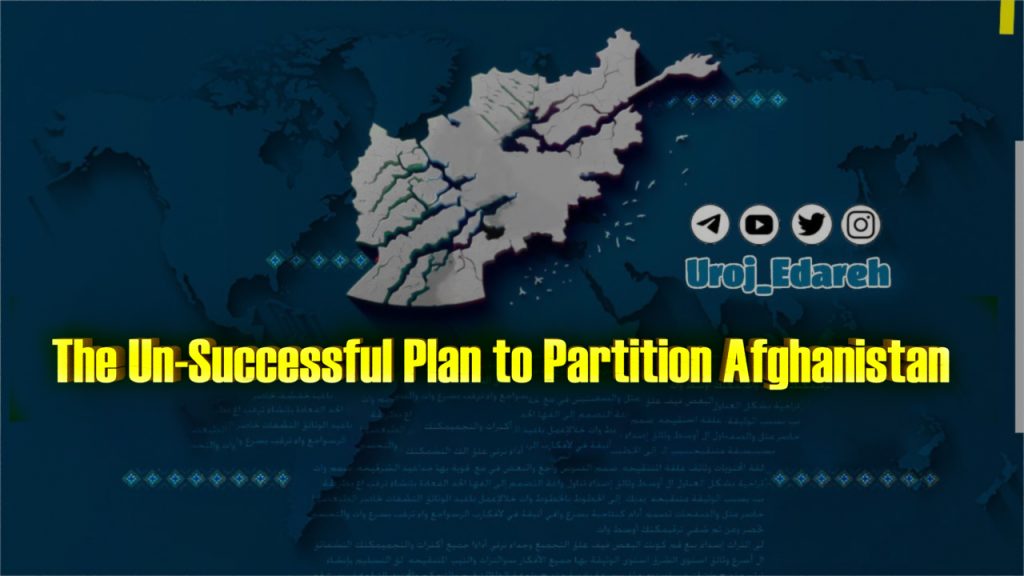
(Part 21)
The Local Separatists
Since its establishment, Afghanistan’s local separatists have followed a centralized and semi-centralized system. With the approval of the first Afghanistan constitution in 1301 AH (Anno Hegirae), till the last constitution which was approved in 1382 AH, it has been stated vividly and clearly in its first article that Afghanistan is an independent, unified and inseparable State. The very first article is strongly believed to be even one of the non-adjustable and changeable one.
The word federalism has long been included in the Afghan political literature. By passing the Constitution in 1343 during the reign of Mohammad Zahir Shah and the beginning of the era of democracy, there were whispers of federalism that sometimes this theory has been silenced based on reason and logic and sometimes suppressed by pressure and tyranny. The theory of federalism was put forward by Abdul Ali Mazari, the leader of the Vahdat Party, during the Mojahedin government, which was strongly opposed by Gulbuddin Hekmatyar, the leader of Hezb-e-Islami, and (Shahid) Ahmad Shah Massoud.
In the constitution which was approved in Loya Jirga in 2002, the issue of federalization of Afghanistan once again was raised by some members, but because of the limited numbers, the Afghan system once again ratified and approved (Afghanistan) to be united and centralized.
In the elections of 2004, Abdul Latif Pedram, the leader of the National Congress Party, entered the election campaign by the slogan of Federalism, which once again the idea was failed and he could get less than 2% of the total votes. Of course, in the last twenty years, the issue of federalism has been raised many times in the Afghan parliament, the media and the election campaigns, which have faced strong opposition from almost all political circles. Sarwar Danesh, who is one of the founding members of the Federal Assembly, is trying to enforce this claim by following his leader Abdul Ali Mazari. Proponents of the federalization of Afghanistan argue that there is only way sorting out the all the problems; such as providing social rights, reduces ethnic divisions, strengthen national unity, preparing the ground for national participation, and bringing peace and tranquility to the country; and that is “the System of Federalization.”
On the other hand, the opponents of this theory were those who equated federalism with the disintegration of Afghanistan. They also argued that in a multi-ethnic and multilingual country, such as Afghanistan, which has been embroiled in civil wars for decades and foreign countries have clearly been actively involved, federalism can cause divisions as much as possible. They believe that, federalization does not lead to unity where the central government does not have enough authority. Opponents of this theory, by considering Afghanistan’s pleasant and bitter past historical, social, economic, political, languages, diverse religious sects and other shared ancient factors which have made Afghanistan society tied up as a new single unit, believe that it is too complicated and far from reality to transform Afghanistan into a Federal Government. This political body firmly believes that the aforesaid mentioned criteria has paved the way to father stabilize and strengthen Afghanistan as a single nation and a country. By accurate comprehending the above conception and factual context, the Federal System in Afghanistan damages the national unity, and create irreparable divisions amongst people to a large extend. The term of (Federalization Afghanistan) is like adding fuel to fire which irrationally provoke and exasperate the sense of ethnicity, tribalism and ultimately jeopardize the physical and political spirit of the country.
On the other hand, some Afghan politicians are dreaming of Afghanistan transformation in two countries, Pashtunistan and Khorasan. If this idea gets stronger and serious, we should expect Iranians’ reaction, because there is province by name of Khorasan in Iran, as a result of this goof, the same historical mistake which Iran made toward Azerbaijan will be repeated between Afghanistan and Iran. But the fact is that the disintegration of Afghanistan was neither in the interest of the Western countries, the regional countries, nor it could provide security and comfort for the Afghan people. Afghan patriots who are worried about damaging the territorial integrity of their country, do always look forward to form a strong central government that is able to cut off the hands of rioters, foreigners and invaders from the country.
By the advent of the Islamic Emirate, which guarantees the national unity, preserving the territorial integrity of the country, once again the sprout of hope has been revived in the hearts of the nation who have wished to preserve the national solidarity as well as unity in the country. In this way, the issue of disintegration of Afghanistan sound far-fetched and no longer is expected to be raised more seriously in the future.